


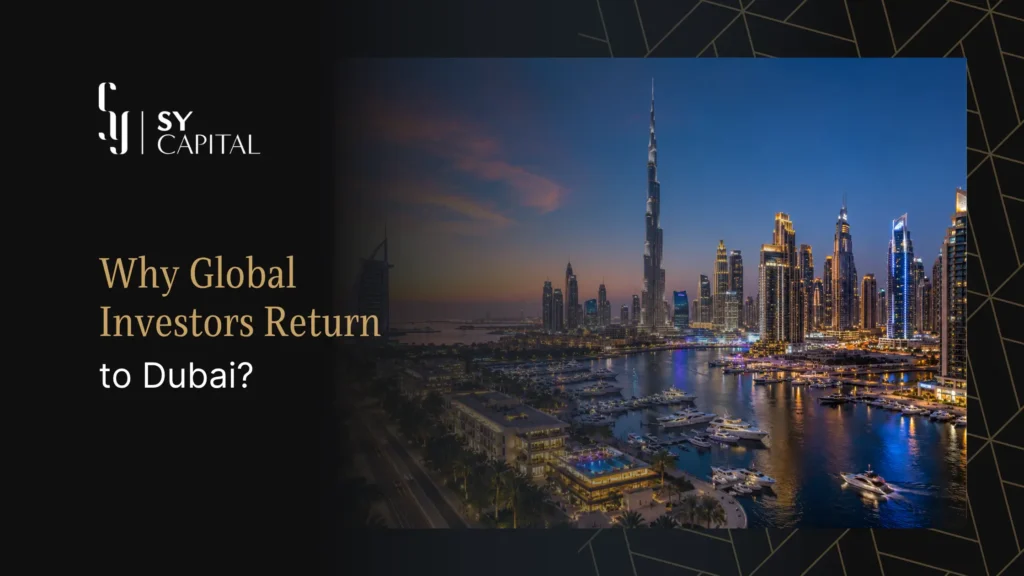
There is a rhythm to Dubai’s real estate story that experienced investors have come to recognise and, increasingly, to rely upon. Markets pause. Sentiment wavers. Prices cool. And then, almost without exception, capital returns — often in greater volume and from a wider pool of nationalities than before. This is not coincidence. It is not luck. It is the outcome of deliberate policy, structural design, and a city that has spent two decades building itself into one of the most investment-friendly real estate ecosystems on the planet.
The question this article addresses is one that sits at the heart of every serious property investment conversation: why does Dubai consistently attract global capital back to its shores after every slowdown, correction, or period of geopolitical uncertainty?
At SY Capital, based in the UAE and deeply embedded in the regional investment landscape, we have observed this cycle at close quarters.
This article is our attempt to decode that pattern — analytically, honestly, and with practical implications for investors evaluating their next move in a market that, right now, presents some of its most compelling entry opportunities in recent years.
Brief History of Dubai’s Market Cycles
To understand why global investors return, you first have to appreciate what they are returning from — and what Dubai offers when they come back.
The 2008 Global Financial Crisis
Dubai’s property market entered the global financial crisis riding one of the most dramatic speculative booms in emerging market history. When the correction arrived, it was severe. Property values fell sharply from their peak, in some segments by more than half. Highly leveraged off-plan purchases, underdeveloped regulatory infrastructure, and a buyer base that had grown accustomed to one-directional price growth all contributed to the scale of the correction.
But the authorities responded with something that would prove more valuable in the long run than any immediate market stimulus: structural reform. Mandatory escrow account legislation was introduced, ensuring that buyer funds could only be used for the construction of the specific project being purchased.
The Real Estate Regulatory Agency (RERA) introduced licensing requirements, dispute resolution mechanisms, and greater transactional transparency. The market was essentially rebuilt on a more honest and durable foundation. When investors returned from 2012 onward, they were returning to a different, more mature ecosystem than the one they had left.
The Oil Price Crash (2014–2016)
The sharp decline in global oil prices between 2014 and 2016 posed a different kind of challenge — one less about speculative excess and more about macroeconomic headwinds. Government revenues fell across the Gulf, public sector employment contracted in some emirates, and the expatriate population growth rate slowed. Dubai’s property market entered a period of price softening and reduced transaction velocity that lasted several years.
Yet even during this period, long-term investors were accumulating. The combination of improved regulatory standards, more realistic valuations, and Dubai’s continued push to diversify its economy away from oil dependency — through trade, tourism, financial services, and logistics — kept institutional confidence relatively intact. When Expo 2020 was awarded to Dubai in 2013, it provided a long-term demand catalyst that anchored forward-looking investment even through the lean years of the mid-decade slowdown.
The COVID-19 Pandemic (2020)
The pandemic was, in terms of suddenness and global scope, unlike anything the Dubai property market had previously navigated. International travel froze overnight. Businesses shuttered. Expatriate populations shrank as white-collar workers returned to their home countries. Tourism, one of Dubai’s primary economic engines, essentially stopped.
By most conventional measures, the conditions for a prolonged market collapse were in place. Yet what happened was remarkable. The UAE government responded with extraordinary policy agility — launching remote work visas, accelerating Golden Visa eligibility, cutting fees, introducing new residency pathways, and opening the country while much of the rest of the world remained locked down. The combination of practical openness and genuine quality of life advantages turned Dubai into a destination of choice for a new class of global mobile professionals.
By late 2021, transaction volumes had not merely recovered — they were breaking decade-long records. And the buyer base that returned was more internationally diversified than at any point in the city’s history, with strong representation from India, Russia, the United Kingdom, France, Italy, and across the broader Middle East.
The 2026 Recalibration
At the time of writing in May 2026, Dubai’s market is navigating a period of adjustment driven by a combination of increased supply coming to market, moderating price growth after a prolonged boom cycle, and some near-term investor caution related to regional geopolitical developments. Property values have seen some softening from their recent peaks, and transaction volumes in certain segments have pulled back from the record highs of 2023 and 2024.
Yet for investors who have followed this market through its previous cycles, the pattern is unmistakable. This is not a structural collapse. It is a recalibration. And recalibrations, in Dubai’s history, have consistently preceded the next phase of expansion.
Seven Structural Reasons Why Global Investors Keep Coming Back
Understanding the cyclical pattern requires understanding the underlying structural pillars that make Dubai different from most other real estate markets. Below, we examine the core reasons why capital keeps returning.
1. The Zero-Tax Advantage Is Real and Structural
In most major global real estate markets, rental income is subject to substantial taxation. In the United Kingdom, residential rental income is taxed as regular income, with higher-rate taxpayers paying 40 percent or more. In France, rental income faces similar rates. In the United States, federal and state taxes combined can consume a significant portion of investment returns. These tax obligations fundamentally alter the economics of property investment and reduce the net yield available to investors.
Dubai has no income tax on rental yields, no capital gains tax on property, and no inheritance tax. This is not a temporary incentive or a special economic zone arrangement — it is a fundamental feature of the UAE’s fiscal architecture. For a high-net-worth individual or family office allocating capital to property, this tax-free framework transforms the effective yield comparison with global alternatives dramatically in Dubai’s favour.
When a Dubai apartment offering a gross yield of seven percent is compared on a net after-tax basis with a London property yielding three percent subject to forty percent income tax, the gap in actual investor returns is enormous. This is not a nuanced advantage — it is a structural one that remains in place regardless of market cycle, and it is a primary reason why capital returns to Dubai whenever alternative markets experience their own difficulties.
2. Rental Yields That Outperform the World’s Leading Cities
Beyond tax advantages, Dubai’s gross rental yields represent a genuine and persistent premium over the world’s most liquid property markets. Average gross yields across Dubai’s residential market typically range between five and nine percent depending on the location, asset type, and management structure. Comparable properties in London, Paris, Singapore, and New York yield between two and four per cent before tax.
This yield differential is particularly important for institutional investors, family offices, and high-net-worth individuals who measure real estate performance against other asset classes. When bond yields are suppressed, and equity markets are volatile — both conditions that have characterised much of the 2020s — the case for Dubai real estate on a risk-adjusted yield basis becomes compelling.
Capital appreciation has also played a sustained role. Dubai’s prime residential market has delivered strong long-term price growth over two decades, even accounting for the corrections of 2008 and the mid-2010s softening. Investors who maintained positions through the cycle and resisted the temptation to exit at the bottom have been significantly rewarded.
3. Regulatory Evolution Has Created Investor Confidence
One of the most significant and underappreciated reasons for Dubai’s investment resilience is the progressive development of its regulatory framework over the past fifteen years.
Following the lessons of 2008, the UAE introduced a series of structural protections that have progressively matured into one of the most transparent property investment frameworks in the emerging world. Escrow account regulations protect buyer funds throughout the construction process. The Dubai Land Department provides a digitised, publicly accessible transaction registry that allows investors to verify comparable sales, ownership history, and project completion status. Real estate agents and brokers must hold RERA certification, reducing the prevalence of unqualified or misleading market intermediaries.
More recently, the introduction of real estate tokenisation initiatives reflects the UAE’s appetite for financial innovation in property markets. Blockchain-based fractional ownership models are being actively explored as a means of improving market liquidity and broadening the accessible investor base — developments that position Dubai at the frontier of global property market evolution.
For international investors comparing Dubai with competing markets in Southeast Asia, Eastern Europe, or other parts of the Middle East, this regulatory sophistication significantly reduces perceived risk and makes capital allocation decisions more straightforward.
4. Developer Financing Structures Have Broadened Market Access
A distinctive feature of Dubai’s off-plan market is the flexible payment plan ecosystem that has developed among the city’s major developers. Rather than requiring buyers to finance the full purchase price upfront or through conventional mortgage arrangements, many Dubai developers offer extended instalment programmes that allow investors to distribute payments across the construction period and beyond.
These structures reduce the initial capital requirement for market entry, allowing investors to gain exposure to Dubai real estate without committing their entire allocation on day one. For globally diversified investors managing multiple positions across asset classes, this ability to enter the market with phased capital deployment is a meaningful practical advantage.
It also has a market-stabilizing effect. Because a significant proportion of Dubai’s off-plan buyers are on structured payment schedules rather than leveraged mortgage positions, forced selling during periods of market stress tends to be lower than in heavily mortgaged markets. This contributes to the resilience of price floors during downturns and helps explain why Dubai’s corrections have historically been less structurally destructive than those in, for example, the US residential mortgage market during 2008.
5. Visa Policy and Residency Incentives Have Transformed Demand
The introduction and progressive expansion of the UAE’s Golden Visa programme has been one of the most consequential policy changes in Dubai’s property market history.
Prior to the Golden Visa era, international property buyers in Dubai held real estate as a financial asset — but without the ability to establish long-term residency, there was a ceiling on the depth of their commitment to the market. The introduction of residency pathways linked to property investment changed this calculus fundamentally.
A buyer who can obtain ten-year residency through a qualifying property purchase is not merely acquiring an investment — they are acquiring a lifestyle option, a safe harbour for their family, and a base from which to manage broader international business or wealth management activities. This transformation in the nature of what Dubai property represents to its buyers has deepened demand, broadened the buyer profile, and created a more committed long-term investor base that is less likely to exit at the first sign of market turbulence.
The expansion of eligibility beyond property investors — to entrepreneurs, skilled professionals, scientists, doctors, and creatives — has also increased the overall pool of potential long-term Dubai residents, supporting the residential demand that underpins both end-user and investor segments of the market.
6. Dubai’s Currency Peg Provides Exchange Rate Stability
For international investors, currency risk is often one of the most significant and least discussed sources of investment return volatility. An investor who achieves a ten percent capital gain on a property denominated in a currency that depreciates twenty percent against their home currency has actually lost money in real terms.
The UAE Dirham has been pegged to the US Dollar since 1997 at a fixed rate of 3.67 dirhams to the dollar. This peg, maintained consistently through oil price shocks, global financial crises, and regional geopolitical events, provides a degree of exchange rate certainty that few other emerging or frontier market property destinations can offer.
For investors from rupee, euro, pound, or other currency environments, the dollar peg means that Dubai property returns translate predictably into global purchasing power. In periods when other currencies are weakening — as the rupee, euro, and pound have experienced at various points in recent years — Dubai’s dollar-linked returns provide a meaningful real currency benefit on top of the underlying investment performance.
7. Dubai’s Global Connectivity and Business Infrastructure Are Irreplaceable
Property values are ultimately anchored by the economic vitality of the city in which they sit. And Dubai’s economic foundation — built on trade, aviation connectivity, financial services, tourism, and logistics — is one of the most diversified and internationally integrated in the world.
Dubai International Airport is one of the busiest passenger airports on earth, connecting the city directly to virtually every major global city. The Jebel Ali Port is among the largest container ports globally and serves as the trade gateway between Asia, Europe, and Africa. The DIFC (Dubai International Financial Centre) functions as a genuinely world-class financial hub operating under English common law — an arrangement that allows global businesses to operate within a familiar legal framework while benefiting from the UAE’s geographic and fiscal advantages.
This economic infrastructure means that demand for Dubai property is supported by real, sustained business activity — not merely speculative enthusiasm or government-directed development. Multinational corporations, regional businesses, and high-net-worth individuals all have genuine operational reasons to be in Dubai, and that operational demand is the bedrock on which investment demand is layered.
Conclusion
If there is one overarching conclusion that two decades of Dubai real estate market history supports, it is this: the cycle repeats, and it rewards those who understand it.
The structural advantages that bring global investors back to Dubai are not temporary marketing narratives — they are embedded in the city’s fiscal architecture, its regulatory framework, its physical infrastructure, its visa policy, and its geographic position at the crossroads of global trade. These advantages do not disappear during corrections. If anything, they become more visible when everything else is stripped away.
The investors who have consistently generated the strongest returns in Dubai have not been those who tried to time the market perfectly. They have been those who understood the city’s structural compellingness, maintained discipline through periods of uncertainty, and committed capital at moments when the majority was hesitating.
At SY Capital, we are here to help our clients do exactly that — with rigorous analysis, local expertise, and a genuine commitment to long-term investment outcomes that stand up to scrutiny.
FAQs
Why do global investors return to Dubai after every market slowdown?
Because Dubai’s fundamentals don’t break during downturns.
What changes is pricing and sentiment — not structure.
Zero tax, high yields, strong regulation, and global connectivity remain intact — making every slowdown a re-entry opportunity for capital.
What makes Dubai real estate structurally attractive compared to global markets?
Three non-negotiables:
0% income tax & capital gains tax
5–9% rental yields (vs 2–4% globally)
Dollar-pegged currency stability
What makes Dubai real estate structurally attractive compared to global markets?
Three non-negotiables:
0% income tax & capital gains tax
5–9% rental yields (vs 2–4% globally)
Dollar-pegged currency stability
This combination is rare — and that’s exactly why capital keeps flowing back.
Why are rental yields in Dubai consistently higher than in other cities?
Because of:
No taxation on rental income
Strong tenant demand (expat-driven economy)
Competitive property pricing vs global cities